Building an AI-Powered MRP Module
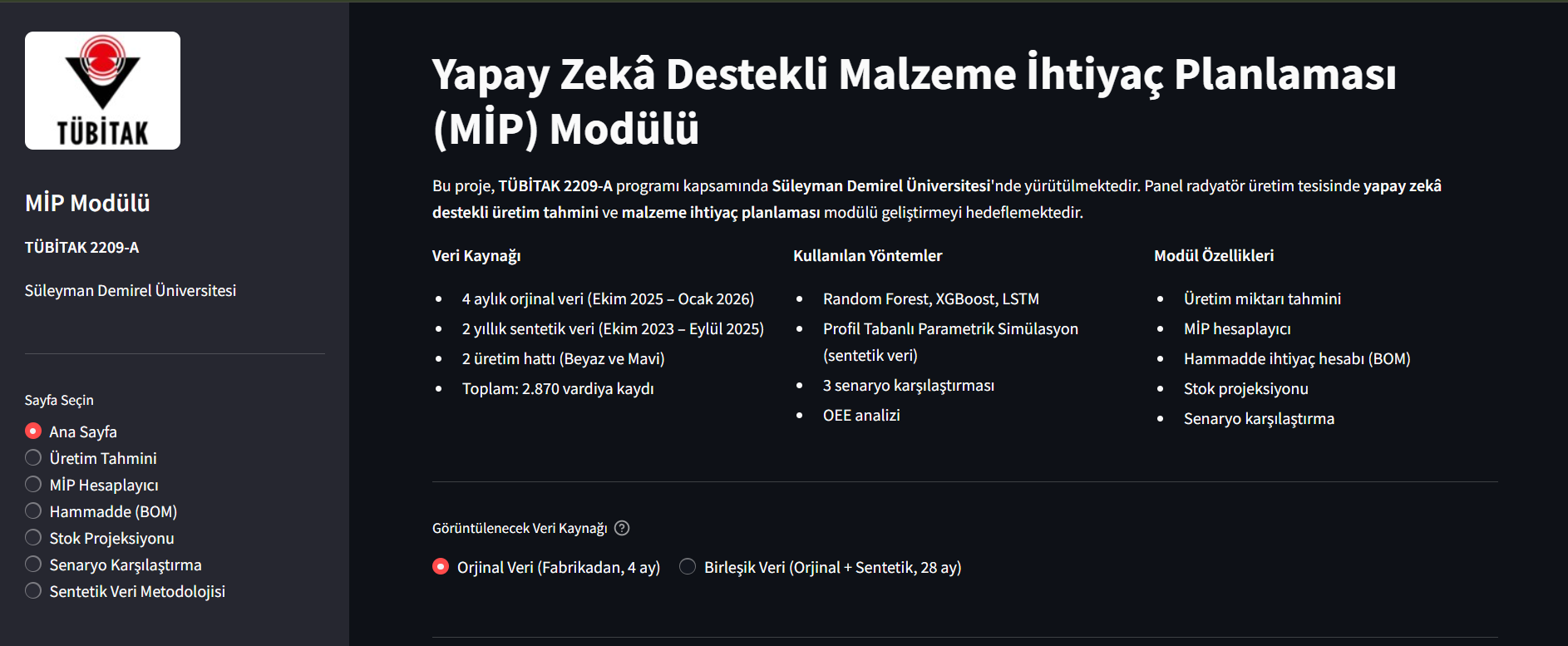
My graduation and TÜBİTAK 2209-A project: AI-driven demand forecasting and material requirements planning (MRP) for panel radiator production.
Problem
A panel radiator manufacturing plant struggled with production planning because its demand forecasting was weak. I had only four months of real production data. Building a reliable forecasting model from such a short series, and then wiring it into material requirements planning, is not straightforward.
My goal was to build an AI-driven demand forecast and feed its output directly into a material requirements planning (MRP) module. I carried out the work both as my TÜBİTAK 2209-A project and as my graduation and design project.
Approach
Since I started with so little data, I first had to grow it. Using profile-based parametric simulation I expanded the four-month sample into 2,870 records, and I validated that the synthetic data matched the real distribution with a Kolmogorov-Smirnov test.
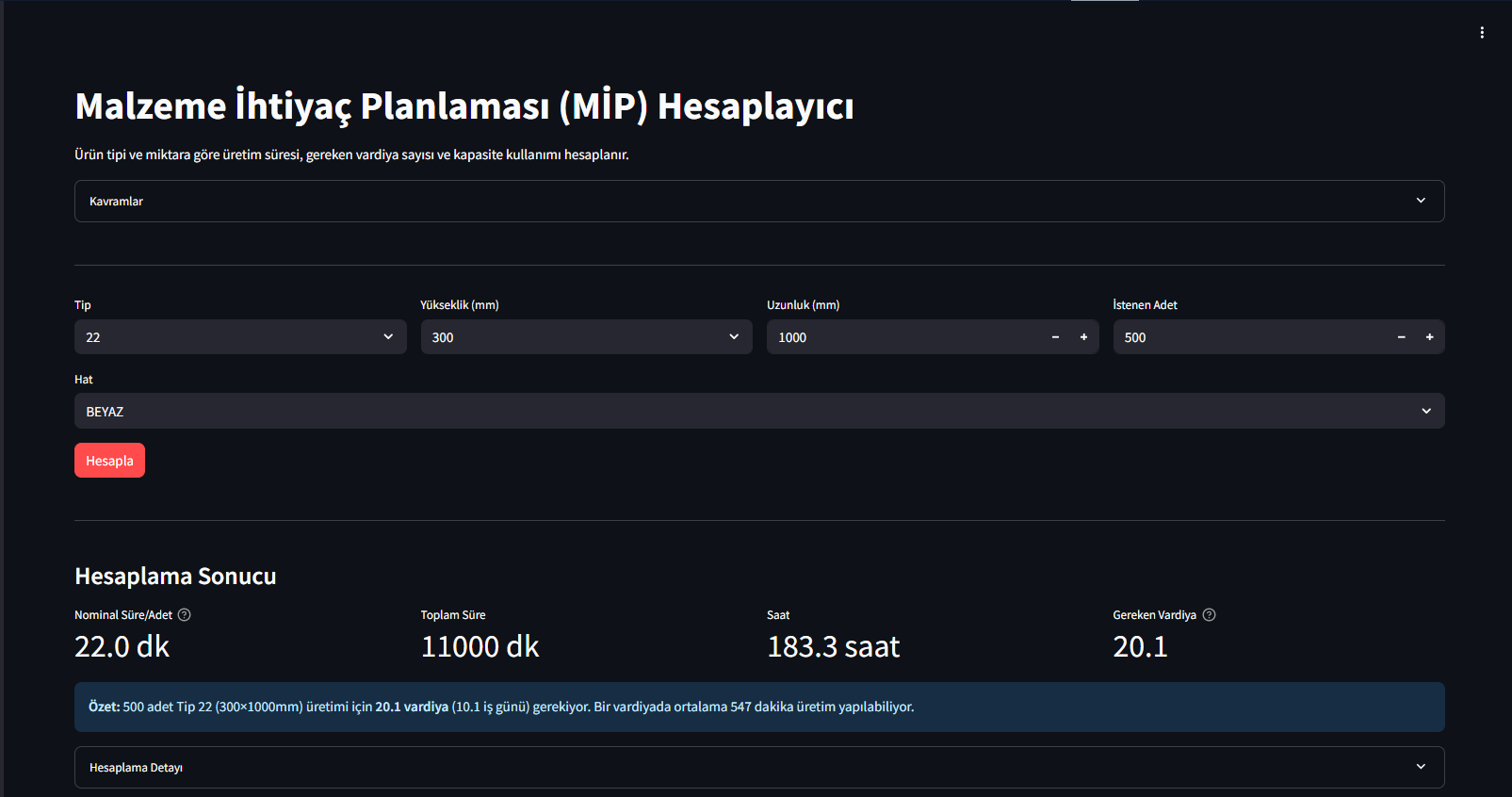
I then compared Random Forest, XGBoost and LSTM across three scenarios, paying particular attention to how sensitive LSTM is to data volume. I connected the forecast output to an MRP module that includes bill-of-materials (BOM) integration, capacity analysis and raw-material calculations. I brought everything together in a seven-page Streamlit application, which is live on Hugging Face Spaces.
Outcome
The best result came from the XGBoost-Combined model on the expanded data: MAE 109.9 and R² 0.657. By feeding demand into the MRP module, the model made material needs and capacity plannable from a single interface.
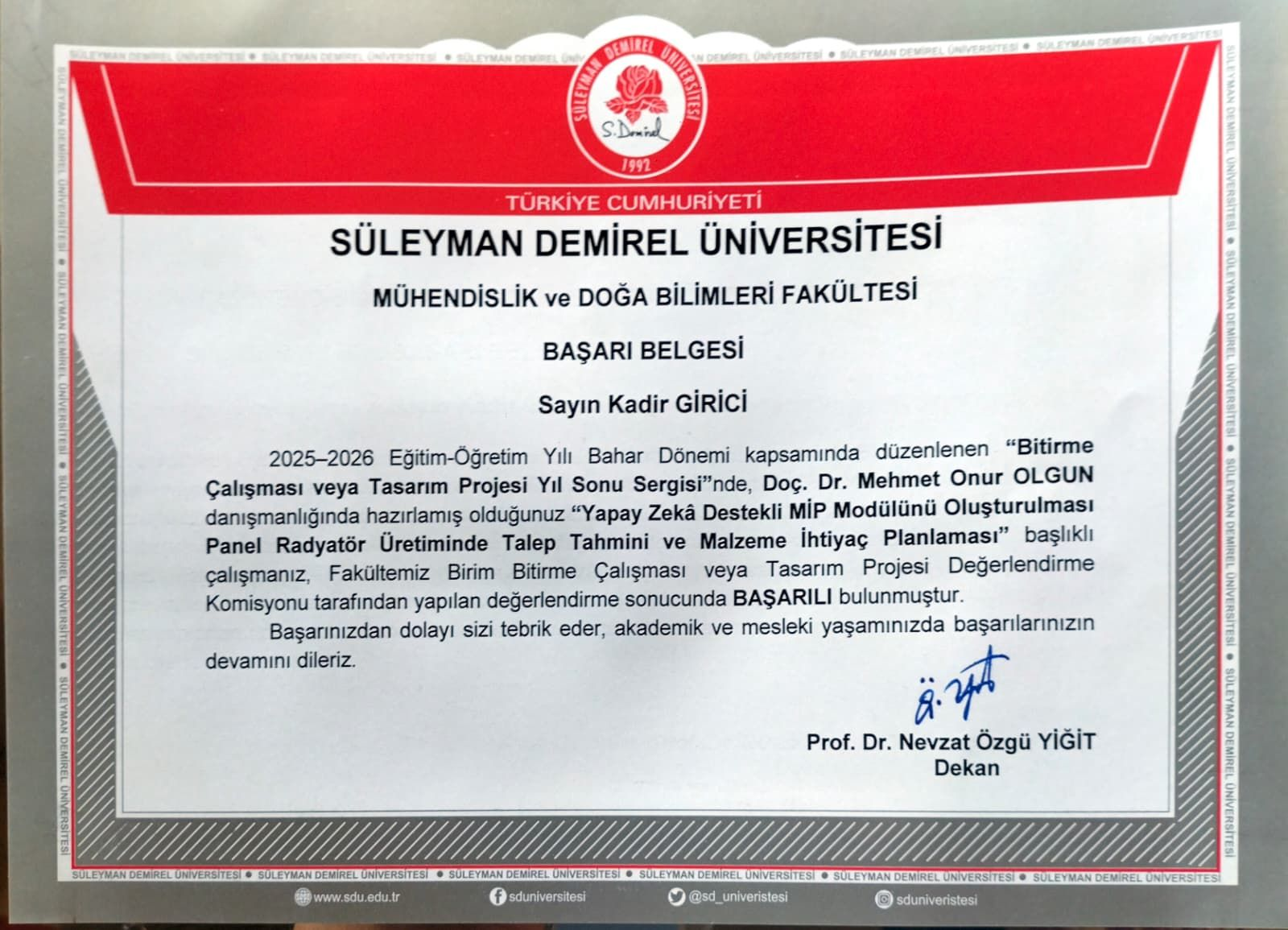
The project was judged successful by the department review committee, earned a distinction, and represented our department at the SDÜ Faculty of Engineering and Natural Sciences Dean's Project Exhibition. I carried it out under the supervision of Assoc. Prof. Mehmet Onur Olgun, together with Ahmet Furkan Doğruyol.
What I learned
The biggest lesson was learning to work with the data constraint itself. Instead of feeding a short series to the model as-is, generating distribution-preserving synthetic data and validating it statistically improved the results noticeably. I saw firsthand that deep models like LSTM did not perform as well as I expected on little data, and that XGBoost was more robust at this scale. Connecting the forecast to an MRP module, rather than leaving it on its own, turned an academic study into a real planning tool.